Special Report
A comprehensive analysis of 165,684 apartment transactions across Dubai, covering volume leaders, price appreciation, rental yields, developer market share, and multi-year trends.
165,684
Total Transactions
+30% YoY
AED 319.9B
Total Market Value
+37% YoY
1,727
Median PSF (AED/sqft)
+5.0% YoY
73%
Off-Plan Share
121,281 transactions
This report analyzes Dubai apartment transactions recorded by the Dubai Land Department (DLD). The following quality filters are applied throughout:
The Big Picture
A city adding 567 new residents every day needs housing to match
Population
3.95M
+176,683 in first 10 months
92% expatriate residents
GDP Growth
AED 355B
+4.7% YoY (9 months)
Real estate: 8.2% of GDP
Tourism
19.59M
Record visitors (+5% YoY)
80.7% hotel occupancy
Construction
+8.5%
Sector growth (AED 23.9B)
6.7% of total GDP
2026 Budget
AED 99.5B
Record government budget
AED 47.8B for infrastructure
Finance Sector
+8.5%
Growth (AED 42.8B)
12% of GDP, largest sector
Dubai's apartment market does not exist in isolation. A city adding nearly 600 residents daily, welcoming a record 19.59 million tourists, and investing AED 47.8 billion in infrastructure is a city that structurally needs more housing. The 4.7% GDP growth, led by financial services and construction, directly feeds housing demand through job creation and population inflows. Understanding this macro context is essential to interpreting the transaction data that follows.
Sources: Dubai Statistics Center, Dubai Department of Economy and Tourism, Dubai Finance Department, Dubai Public Debt Management Office
Section 1
A record year built on fundamentals, not speculation
Dubai's apartment market recorded a landmark year in 2025, with 165,684 transactions worth a combined AED 319.9 billion. This represents a 30.5% increase in volume and a 36.7% increase in total value compared to 2024, when 126,969 transactions totalled AED 233.9 billion.
Off-plan sales were the primary growth engine, surging 37.7% year-on-year to 121,281 transactions. Ready (secondary market) sales grew at a more moderate 14.1%, reaching 44,403 transactions. The median price per square foot across all apartment sales rose 5.0% to AED 1,727, reflecting continued but measured price appreciation.
The value growth (+36.7%) outpacing volume growth (+30.5%) indicates a compositional shift toward higher-value transactions, driven in part by new off-plan launches in premium locations such as Dubai Maritime City, Palm Jumeirah, and Business Bay.
Market Context
Dubai's total property market recorded over 270,000 transactions across all asset classes in 2025, with a combined value exceeding AED 917 billion. Apartments accounted for approximately 61% of total transaction volume, making this segment the single largest driver of market activity. The apartment figures in this report represent the core of Dubai's residential investment landscape.
| Metric | 2024 | 2025 | YoY Change |
|---|---|---|---|
| Ready Sales | 38,902 | 44,403 | +14.1% |
| Off-Plan Sales | 88,067 | 121,281 | +37.7% |
| Total | 126,969 | 165,684 | +30.5% |
| Market Value | AED 233.9B | AED 319.9B | +36.7% |
Section 2
Established communities hold their ground as new corridors emerge
A two-tier market structure has taken shape. Jumeirah Village Circle and Business Bay together accounted for approximately 18% of all apartment transactions in 2025, cementing their roles as the twin engines of Dubai's residential market. JVC led by sheer volume with 21,873 transactions, while Business Bay led by value at AED 31.7 billion, reflecting its higher price point and premium positioning along the Canal corridor.
The more revealing story lies further down the table. Dubai Investment Park Second surged to fourth place with 7,427 transactions, a dramatic jump driven by value-oriented off-plan launches attracting mid-market buyers. Al Furjan and Dubai Hills Estate entered the top 10 for the first time, reflecting the expansion of Dubai's residential footprint into master-planned suburban corridors. Dubai Hills Estate is particularly notable: ranking ninth by volume but second by total value at AED 22.0 billion, reflecting its premium positioning and larger unit sizes.
What Drove the Numbers
JVC was propelled almost entirely by off-plan launches. Binghatti Circle led with 748 transactions, followed by Binghatti Amberhall at 546 and Binghatti Ruby at 468. The only significant ready-market project in the top 15, AKA Residence at AED 843 PSF, accounted for just 210 transactions, underscoring the off-plan dominance.
Business Bay volume was heavily concentrated in Binghatti's Skyrise towers, which together recorded 2,670 transactions across three towers at a median AED 2,577-2,600 PSF. Bayz 102 by Danube added another 626 transactions at a higher AED 3,123 PSF, positioning itself as a premium alternative within the same corridor.
Dubai Maritime City recorded 100% off-plan activity among its top projects. Breez by Danube led with 484 transactions at AED 3,502 PSF, followed by Franck Muller Yachting by London Gate at 426 transactions. Multiple Beyond-branded projects, including Talea, Sensia, and The Mural, further diversified the developer mix in this emerging waterfront district.
| # | Community | Transactions | Value (AED M) | Median PSF |
|---|---|---|---|---|
| 1 | Jumeirah Village Circle | 21,873 | 23,479 | 1,400 |
| 2 | Business Bay | 14,711 | 31,705 | 2,339 |
| 3 | Dubailand Residence Complex | 8,849 | 7,395 | 1,287 |
| 4 | Dubai Investment Park Second | 7,427 | 23,213 | 1,548 |
| 5 | Dubai Marina | 6,466 | 14,554 | 2,061 |
| 6 | Dubai Production City | 6,065 | 4,925 | 1,322 |
| 7 | Jumeirah Village Triangle | 5,951 | 7,351 | 1,521 |
| 8 | Al Furjan | 5,898 | 11,826 | 1,291 |
| 9 | Dubai Hills Estate | 5,691 | 21,991 | 2,301 |
| 10 | Dubai Science Park | 5,614 | 7,139 | 1,649 |
Key Insight
Seven of the top 10 communities by volume have a median PSF below AED 2,000, indicating that the bulk of market activity is concentrated in the mid-market segment rather than the ultra-premium tier. Together, these 10 communities represent approximately 42% of the total apartment market, a significant concentration that underscores the importance of corridor-level analysis over citywide averages.
Section 3
Broad-based gains across price tiers, led by emerging value corridors
The headline 5% market-wide PSF gain understates what happened at the community level. The more important story is where growth occurred. Among the top 10 appreciation leaders, the majority are mid-market communities with 2025 median PSF figures below AED 1,300. Uptown Motorcity, Al Furjan, Jumeirah Village Triangle, Dubai Investment Park, Town Square, and Liwan all fall into this bracket. This pattern points to value-seeking capital rotating into perceived underpriced corridors, a classic sign of a broadening market rather than a narrow speculative rally.
Top 10 communities by year-on-year change in median ready-sale price per square foot. Only communities with a minimum of 20 transactions in 2024 and 30 in 2025 are included.
| # | Community | 2024 PSF | 2025 PSF | YoY | Txns 2025 |
|---|---|---|---|---|---|
| 1 | DIFC | 2,224 | 3,096 | +39.2% | 714 |
| 2 | Victory Heights | 1,421 | 1,892 | +33.1% | 106 |
| 3 | Al Wasl | 2,204 | 2,872 | +30.3% | 270 |
| 4 | Uptown Motorcity | 754 | 973 | +29.1% | 725 |
| 5 | The Meadows | 2,274 | 2,920 | +28.4% | 146 |
| 6 | Jumeirah Village Triangle | 1,171 | 1,460 | +24.6% | 850 |
| 7 | Jumeirah Golf Estates | 1,671 | 2,066 | +23.6% | 360 |
| 8 | Jumeirah Park | 1,705 | 2,104 | +23.4% | 188 |
| 9 | Emaar South | 982 | 1,198 | +22.0% | 403 |
| 10 | Town Square | 1,063 | 1,295 | +21.8% | 1,183 |
Key Insight
DIFC's 39.2% headline gain leads the appreciation table, driven by both genuine premium demand and the delivery of several ultra-high-value units during 2025. With 714 ready transactions, this is a statistically robust result. DIFC's performance reflects the concentration of institutional-grade demand in Dubai's financial district, where limited supply meets growing corporate relocation activity.
What Drove the Numbers
DIFC: DIFC Heights Tower recorded 337 transactions at a median AED 4,132 PSF in 2025, having barely appeared in 2024 rankings. This single building accounted for nearly half of DIFC's total volume and pulled the community median sharply upward. Meanwhile, Burj Daman showed genuine appreciation, rising from AED 2,201 to AED 2,904 PSF, a 32% gain across 44 transactions.
Al Furjan: Nadine 1 and Nadine 2 Residences drove the community's 29% appreciation, each gaining approximately 30% from around AED 1,030 to AED 1,340 PSF. Topaz Avenue also contributed with a 28% gain.
Dubai Sports City: Appreciation was remarkably broad-based. Six buildings registered gains between 27% and 34%, led by Uniestate Sports Tower at 33.7% and Elite 4 at 32.6%. This breadth across the community suggests genuine demand uplift rather than project-specific factors.
Dubailand Residence Complex: DRC Maya 3 jumped 127.5% from AED 570 to AED 1,297 PSF, but this likely reflects a composition shift from legacy inventory to newly completed product rather than pure appreciation of the same stock.
Section 4
A 73% off-plan share signals developer and buyer alignment, not speculation
Off-Plan Share 2024
69.4%
88,067 of 126,969
Off-Plan Share 2025
73.2%
121,281 of 165,684
Composition Shift
+3.8pp
Toward off-plan
2024 Split
2025 Split
The off-plan segment expanded its share of the total market from 69.4% in 2024 to 73.2% in 2025, a 3.8 percentage-point shift. Both segments grew in absolute terms, but the off-plan pace far exceeded the ready segment at 37.7% versus 14.1%.
Average transaction values show an interesting divergence: ready sales averaged AED 1.76 million per transaction in 2025, while off-plan sales averaged AED 1.99 million. This premium reflects the concentration of off-plan launches in higher-PSF locations, including new masterplan communities and waterfront developments.
The sustained dominance of off-plan activity underscores continuing developer confidence and strong end-user and investor demand for newly launched projects. However, the ready market's solid 14.1% growth indicates healthy secondary market liquidity.
What Drove the Numbers
The off-plan surge was not evenly distributed. A handful of high-volume projects accounted for a disproportionate share: the Binghatti Skyrise trilogy in Business Bay recorded 2,670 off-plan transactions, Binghatti Elite in Dubai Production City added 1,689, and Sobha's Solis towers in Uptown Motorcity contributed over 2,000 combined. Meanwhile, ready-market volume was distributed across a much larger pool of established buildings with lower per-project counts. This asymmetry, where a few mega-launches dominate off-plan numbers while the ready market operates through fragmented resale activity, explains why off-plan growth consistently outpaced the ready segment.
Market Context
Unlike earlier cycles, today's off-plan market operates under RERA oversight with mandatory escrow accounts that protect buyer payments during construction. Post-handover payment plans, now common among major developers, further distribute risk. These structural safeguards differentiate the current 73% off-plan share from the pre-2008 period, when fewer regulatory protections were in place.
Section 5
New product commanding double the price of existing stock in some corridors
The largest off-plan premiums are not in the waterfront luxury corridors where one might expect them. Uptown Motorcity leads at 107% and Dubai Silicon Oasis follows at 89%, both suburban communities where the ready stock consists primarily of legacy towers built 15-20 years ago at median PSF figures of AED 700-950. The new off-plan launches in these same communities are priced at AED 1,800-2,000 PSF, reflecting a fundamentally different product: newer specifications, modern amenities, and contemporary design. This is a product differentiation story, not a speculative premium.
Communities where off-plan median PSF exceeds ready-market median PSF. Only communities with a minimum of 15 ready and 15 off-plan transactions are included.
| Community | Ready PSF | Off-Plan PSF | Premium | Ready N | Off-Plan N |
|---|---|---|---|---|---|
| Uptown Motorcity | 952 | 1,975 | +107.4% | 723 | 3,635 |
| Dubai Silicon Oasis | 902 | 1,823 | +102.2% | 1,395 | 2,605 |
| Palm Jumeirah | 2,552 | 4,957 | +94.2% | 923 | 382 |
| Dubailand Res. Complex | 829 | 1,400 | +68.8% | 1,100 | 6,640 |
| Dubai Sports City | 883 | 1,464 | +65.7% | 1,491 | 1,716 |
| Dubai Marina | 1,806 | 2,898 | +60.5% | 2,528 | 1,962 |
| Business Bay | 1,784 | 2,631 | +47.5% | 3,256 | 8,628 |
| Downtown Dubai | 2,641 | 3,581 | +35.6% | 2,161 | 1,465 |
| JVC | 1,276 | 1,532 | +20.1% | 5,247 | 12,268 |
Key Insight
The age gap between ready stock and new launches, typically 15-20 years, is the primary driver of off-plan premiums in suburban communities. Buyers are paying for product differentiation rather than location premium. The open question is whether these premiums will sustain post-delivery, when the new product enters the ready market and competes directly with neighboring legacy stock on a per-square-foot basis.
What Drove the Numbers
Uptown Motorcity (+107%): The entire off-plan volume was a single developer story. Sobha's Solis towers A through D and Orbis towers E through G accounted for all significant off-plan activity at AED 1,887-2,105 PSF. There were no ready transactions in the community's top 10, meaning the 107% premium is measured against a small ready sample of legacy Motor City stock.
Dubai Silicon Oasis (+89%): The premium gap is visible at the building level. Off-plan Timez by Danube led with 1,059 transactions at AED 1,971 PSF, while the most-traded ready building, Silicon Gates 1, recorded just 103 transactions at AED 834 PSF. This 2.4x price gap within the same community starkly illustrates the product differentiation dynamic.
Business Bay (+47.5%): Even in a premium corridor, the gap persists. Binghatti Skyrise towers traded at AED 2,577-2,660 PSF off-plan, compared to established ready towers at AED 1,784 PSF median. The scale of off-plan activity in Business Bay, at 8,628 transactions versus 3,256 ready, confirms that new launches dominate the pricing narrative.
Section 6
The yield-appreciation tradeoff reveals two distinct investor strategies
The yield table reveals an inverse relationship between gross yield and price per square foot. International City leads at 8.3% with the lowest sale PSF in the ranking at AED 640. Dubai Sports City follows at 7.9% with a sale PSF of AED 883. These are income-focused communities where investors prioritize cash flow over capital appreciation. The lower entry cost per square foot mechanically produces a higher rental yield, but it also reflects a mature rental market with established tenant demand and predictable occupancy.
At the other end, premium communities like Dubai Marina at 5.8% and Business Bay at 6.0% offer lower yields but compensate with deeper liquidity, stronger historical appreciation, and a more diversified tenant base. The 250 basis-point spread between the highest and lowest yields in this ranking is notably narrow by emerging-market standards, suggesting that Dubai's rental market has matured to the point where yield compression across tiers is well advanced.
Gross rental yield calculated from 2025 ready-sale median PSF versus rental median PSF. Size consistency validated: all listed communities show less than 30% median size deviation between sales and rental samples.
| # | Community | Sale PSF | Rent PSF | Yield | Confidence |
|---|---|---|---|---|---|
| 1 | International City | 640 | 53 | 8.3% | HIGH |
| 2 | Dubai Sports City | 883 | 70 | 7.9% | HIGH |
| 3 | Dubai Production City | 951 | 73 | 7.7% | HIGH |
| 4 | Discovery Gardens | 870 | 64 | 7.4% | HIGH |
| 5 | Dubailand Res. Complex | 829 | 58 | 7.0% | HIGH |
| 6 | Al Furjan | 1,274 | 88 | 6.9% | HIGH |
| 7 | Dubai Silicon Oasis | 902 | 62 | 6.9% | HIGH |
| 8 | Jumeirah Lake Towers | 1,418 | 97 | 6.8% | HIGH |
| 9 | Meydan One | 1,968 | 133 | 6.8% | HIGH |
| 10 | JVC | 1,276 | 85 | 6.7% | HIGH |
| 11 | Town Square | 1,288 | 82 | 6.4% | HIGH |
| 12 | Sobha Hartland | 2,105 | 131 | 6.2% | HIGH |
| 13 | Dubai Hills Estate | 2,304 | 139 | 6.0% | HIGH |
| 14 | Business Bay | 1,784 | 107 | 6.0% | HIGH |
| 15 | Dubai Marina | 1,806 | 105 | 5.8% | HIGH |
Key Insight
Every community in this ranking exceeds 5.5% gross yield, a figure that compares favorably to residential yields in London, Singapore, and Hong Kong, where gross yields typically range from 3-4%. Combined with zero personal income tax on rental income, Dubai's yield profile remains attractive by global standards. DLD data shows approximately 193,100 active property investors in 2025, a 24% increase year-on-year, suggesting continued capital inflow from international buyers seeking yield in a tax-efficient jurisdiction.
What Drove the Numbers
International City (8.3% yield): Building-level analysis reveals yields as high as 11.7% at CBD 27 Belvedere Residences, where the median sale PSF of AED 524 against annual rent PSF of AED 61 creates an exceptional income return. The Morocco, Italy, England, and Emirates clusters consistently recorded yields between 9.8% and 10.5%, all supported by sale prices below AED 610 PSF. These are legacy buildings with established tenant bases and minimal vacancy, making them pure cash-flow plays.
The yield stratification within International City is itself instructive: newer developments like the Lawnz Residence blocks trade at AED 1,077-1,117 PSF, roughly double the legacy cluster pricing. As these newer buildings establish rental track records, their yields will likely converge toward 6-7%, mechanically reducing the community-level average over time.
Global Perspective
70% cheaper than London, with triple the yield and zero income tax
Dubai's value proposition becomes clearest in a global context. At an average of approximately USD 550 per square foot, Dubai's residential prices are a fraction of comparable global cities. London commands approximately USD 1,900 per square foot, Singapore around USD 2,100, and Hong Kong leads globally at USD 3,860. Yet Dubai's rental yields of 5.8-8.3% across the communities in this report substantially exceed the 2-4% range typical of those same cities, and all rental income is received tax-free.
This yield-price combination is a key driver of the foreign investment surge documented earlier in this report. For an investor comparing a London apartment yielding 3% after income tax of up to 45%, versus a Dubai apartment yielding 7% with zero income tax, the arithmetic is compelling. The 193,100 active investors in Dubai's market, up 24% year-on-year, suggest this calculation is being made with increasing frequency.
Average Price Per Square Foot (USD)
Gross Rental Yield vs Income Tax Rate
| City | Avg PSF (USD) | Gross Yield | Income Tax | Net Yield (est.) |
|---|---|---|---|---|
| Dubai | $550 | 5.8 – 8.3% | 0% | 5.8 – 8.3% |
| London | $1,900 | 2 – 4% | Up to 45% | 1.1 – 2.2% |
| Singapore | $2,100 | 3 – 4% | Up to 22% | 2.3 – 3.1% |
| New York | $1,600 | 3 – 5% | Up to 37% | 1.9 – 3.2% |
| Hong Kong | $3,860 | 2 – 3% | Up to 17% | 1.7 – 2.5% |
Sources: Global Property Guide, Phoree Research, Savills World Cities Prime Residential Index. Net yield estimates assume top marginal income tax rate applied to rental income. Actual net yields vary by investor tax residency and deductions.
Section 7
One-bedrooms account for nearly half the market, reflecting both investor and end-user demand
2025 apartment transactions by bedroom count, split between off-plan and ready segments.
| Bedrooms | Off-Plan | Ready | Total | Share |
|---|---|---|---|---|
| Studio | 31,599 | 9,823 | 41,422 | 25.0% |
| 1 BR | 54,970 | 18,610 | 73,580 | 44.4% |
| 2 BR | 27,896 | 11,839 | 39,735 | 24.0% |
| 3 BR | 5,889 | 3,615 | 9,504 | 5.7% |
| 4+ BR | 857 | 437 | 1,294 | 0.8% |
| Total | 121,211 | 44,324 | 165,535 | 100% |
1-bedroom apartments dominated the market at 44.4% of all sales, followed by studios at 25.0% and 2-bedrooms at 24.0%. The concentration in smaller units reflects both the investor-driven nature of the off-plan market, where compact units offer lower entry points, and end-user demand from the growing young professional population. The 3-bedroom and 4+ bedroom segments combined accounted for just 6.5% of total sales.
Investor Demographics
Over 30,000 investors from 150+ countries in the first nine months alone
Dubai's apartment market is among the most internationally diversified in the world. No single nationality dominates: Indian buyers lead at 22% market share, followed by British investors at 17%, Chinese at 14%, Saudi Arabian at 11%, and Russian at 9%. The remaining 27% is fragmented across 150+ nationalities, from Canadians and French to Pakistanis and Egyptians.
Investment strategies vary by origin. Buyers from India, Pakistan, and Iran tend to focus on mid-market assets with strong rental yields, targeting communities like JVC, International City, and Dubai Silicon Oasis. UK, Saudi, and Chinese investors skew toward premium properties in Downtown Dubai, Palm Jumeirah, and Dubai Marina, where higher ticket sizes align with wealth preservation and lifestyle priorities. This diversity of buyer motivation, spanning cash flow, capital appreciation, residency, and lifestyle, is itself a source of market resilience.
Active Investors
193,100
+24% year-on-year
Countries Represented
150+
Most diverse market globally
Top Market Value
AED 30B+
Indian investor projection 2025
Market Context
The geographic diversity of Dubai's buyer base acts as a natural hedge against single-country economic shocks. When Russian capital inflows moderated in 2024, Indian and Chinese investment accelerated to fill the gap. This rotation effect, where different nationality cohorts lead at different points in the cycle, is a structural advantage that few global property markets can match. The golden visa program, which grants 10-year residency to property investors, continues to serve as a powerful catalyst, particularly for buyers from South and East Asia.
Sources: DXB Interact, Dubai Land Department, Khaleej Times. Nationality shares based on 2025 transaction registration data.
Section 8
The mid-market drives volume, but the luxury segment is growing fastest
Where you buy matters more than when. Breaking 165,684 apartment sales into five price tiers reveals a market with distinct dynamics at each level. The AED 1-2 million bracket leads in volume with 67,097 transactions, but the fastest growth is at the extremes: the 5M+ luxury tier surged 60.5% year-on-year, while the sub-500K entry level was the only segment to contract. This upward migration of capital reflects both rising prices and a deliberate shift toward premium product.
| Price Tier | Transactions | Share | YoY Change | Median PSF | Median Value | Total Value |
|---|---|---|---|---|---|---|
| Under AED 500K | 5,820 | 3.5% | −12.9% | 940 | 430,000 | AED 2.4B |
| AED 500K – 1M | 45,540 | 27.5% | +21.1% | 1,499 | 735,282 | AED 33.9B |
| AED 1M – 2M | 67,097 | 40.5% | +43.1% | 1,605 | 1,324,000 | AED 92.9B |
| AED 2M – 5M | 40,151 | 24.2% | +27.8% | 2,455 | 2,652,858 | AED 116.1B |
| AED 5M+ | 7,076 | 4.3% | +60.5% | 3,769 | 7,213,500 | AED 74.5B |
Largest Segment
AED 1M–2M
40.5% of all transactions
Highest Value Segment
AED 2M–5M
AED 116.1B total market value
Fastest Growing
5M+ ↑60.5%
7,076 luxury transactions
Key Insight
The sub-500K tier is the only segment that contracted year-on-year, down 12.9%. This is not declining demand at the entry level but rather a pricing floor that has risen: apartments that traded at AED 450K in 2024 now register at AED 550K, pushing them into the next tier. Meanwhile, the 5M+ luxury segment grew 60.5%, representing over AED 74.5 billion in transactions. This acceleration is driven by waterfront communities: Dubai Harbour led with 1,028 transactions, followed by Downtown Dubai at 781 and Palm Jumeirah at 639.
Where Each Tier Lives
Under 500K: International City dominates with 1,302 transactions, followed by JVC at 497 and Dubailand Residence Complex at 449. These are predominantly studios and small one-bedrooms in affordable corridors.
500K–1M: JVC leads massively with 8,176 transactions, reflecting its role as the city's primary mid-market hub. Dubailand Residence Complex at 4,826 and Dubai Production City at 3,417 round out a tier dominated by suburban off-plan communities.
1M–2M: JVC still leads at 8,187, but Business Bay enters at 6,088 and Uptown Motorcity at 3,760. This is where suburban and urban corridors begin to overlap.
2M–5M: Business Bay takes the lead at 4,512, joined by Dubai Islands at 3,305 and Dubai Maritime City at 3,291. The shift from suburban to waterfront and urban core is clear.
5M+: Entirely waterfront: Dubai Harbour at 1,028, Downtown Dubai at 781, and Palm Jumeirah at 639. This tier operates on a different set of demand drivers, primarily end-user and lifestyle purchases.
Section 9
A new market leader emerges while legacy developers shift toward value
The developer leaderboard tells a story of strategic differentiation. Binghatti, a relatively newer entrant compared to legacy players, has risen to the top of the volume table with 19,389 units across 79 projects. Its strategy is high-volume, mid-market positioning at a median PSF of AED 1,945, targeting the price bracket where the bulk of buyer demand resides. By contrast, Emaar, which led the market for over a decade, now ranks third by unit count but first by total value at AED 25.8 billion, with the highest median PSF among the top five at AED 2,408. This is a deliberate pivot toward quality and location premium.
| # | Developer | Units Sold | Projects | Value (AED M) | Median PSF |
|---|---|---|---|---|---|
| 1 | Binghatti | 19,389 | 79 | 27,576 | 1,945 |
| 2 | Sobha | 9,886 | 48 | 20,449 | 2,315 |
| 3 | Emaar | 9,233 | 167 | 25,792 | 2,408 |
| 4 | Damac | 7,863 | 99 | 14,582 | 1,610 |
| 5 | Samana | 4,502 | 47 | 4,717 | 1,544 |
| 6 | Danube | 4,413 | 30 | 7,162 | 2,057 |
| 7 | Azizi | 3,089 | 82 | 2,678 | 1,662 |
| 8 | Imtiaz | 2,744 | 31 | 4,121 | 1,663 |
| 9 | Ellington | 2,626 | 40 | 6,249 | 2,122 |
| 10 | Hijazi | 2,345 | 10 | 2,660 | 1,657 |
What Drove the Numbers
Binghatti's geographic spread is a defining characteristic. Its top project, Binghatti Elite in Dubai Production City, recorded 1,689 transactions at AED 1,331 PSF, the lowest price point among its portfolio. Hillviews in Dubai Science Park followed with 1,464 transactions at AED 1,661 PSF. The three Skyrise towers in Business Bay combined for 2,670 transactions at a higher AED 2,577-2,660 PSF. Binghatti Circle in JVC added 748 and Binghatti Flare in JVT contributed 731, demonstrating a strategy of saturating multiple communities simultaneously at mid-market pricing.
Emaar's portfolio tells a different story: concentrated in premium masterplans. Dubai Creek Harbour alone produced four projects in its top 10, including Albero at 426 transactions, Montiva at 397, and Altan at 394, all in the AED 2,453-2,587 PSF range. Dubai Hills Estate contributed Rosehill and Parkwood at AED 2,288-2,565 PSF. This focus on fewer, higher-value communities at AED 2,025-2,687 PSF explains how Emaar achieves the highest total value at AED 25.8 billion while ranking third in unit count.
Sobha's surprise as the second-largest developer by volume was driven almost entirely by two masterplan communities: the Solis and Orbis tower families in Uptown Motorcity, where it held a near-monopoly on supply.
Market Context
The diversity of the top 10 developer list, spanning publicly listed companies, privately held developers, and newer entrants, reflects a competitive market structure that benefits buyers through product differentiation. No single developer holds more than 14% of the off-plan market by unit volume, and the top three collectively account for approximately 30%. Emaar's focus on competing through quality and location premium rather than volume signals a mature developer landscape where multiple viable strategies coexist.
Section 10
Five consecutive years of growth have confounded the skeptics
Six-year trend showing the evolution of Dubai's apartment market from the pandemic trough through the current cycle.
| Year | Transactions | Median PSF | PSF Change |
|---|---|---|---|
| 2020 | 18,515 | 1,080 | — |
| 2021 | 33,146 | 1,206 | +11.7% |
| 2022 | 60,057 | 1,535 | +27.3% |
| 2023 | 91,823 | 1,542 | +0.5% |
| 2024 | 126,969 | 1,644 | +6.6% |
| 2025 | 165,684 | 1,727 | +5.0% |
Volume Growth (2020-2025)
8.9x
From 18,515 to 165,684 transactions
Cumulative PSF Appreciation
+60%
From AED 1,080 to AED 1,727
Since 2020, apartment transaction volume has grown 8.9 times while median PSF increased 60%. The pace of price growth has moderated from 27.3% in 2022 to 5.0% in 2025, suggesting a maturing cycle where volume expansion continues but price acceleration has tempered. The near-flat PSF growth of 0.5% in 2023 followed by moderate gains in 2024 and 2025 indicates a market that has absorbed the initial recovery surge and settled into a more sustainable growth trajectory.
Market Context
The five-year compound annual growth rate for apartment PSF stands at approximately 10%, a figure that would have surprised international rating agencies that anticipated 10-15% price corrections as recently as 2023. Instead, a combination of sustained population inflows, expanded residency initiatives including golden visas and remote work permits, and diversification of the economic base has supported continuous growth. The moderation from 27.3% annual PSF growth in 2022 to 5.0% in 2025 represents normalization toward long-term sustainable rates, not weakness.
Looking Ahead
Generational infrastructure bets that will reshape connectivity and property values
Dubai's real estate trajectory cannot be understood in isolation from the infrastructure investments currently underway. Three mega-projects, collectively representing over AED 200 billion in committed capital, will fundamentally alter the city's geography of value over the next decade. Each project creates new corridors of connectivity, shifts commuter patterns, and opens previously peripheral communities to mainstream demand.
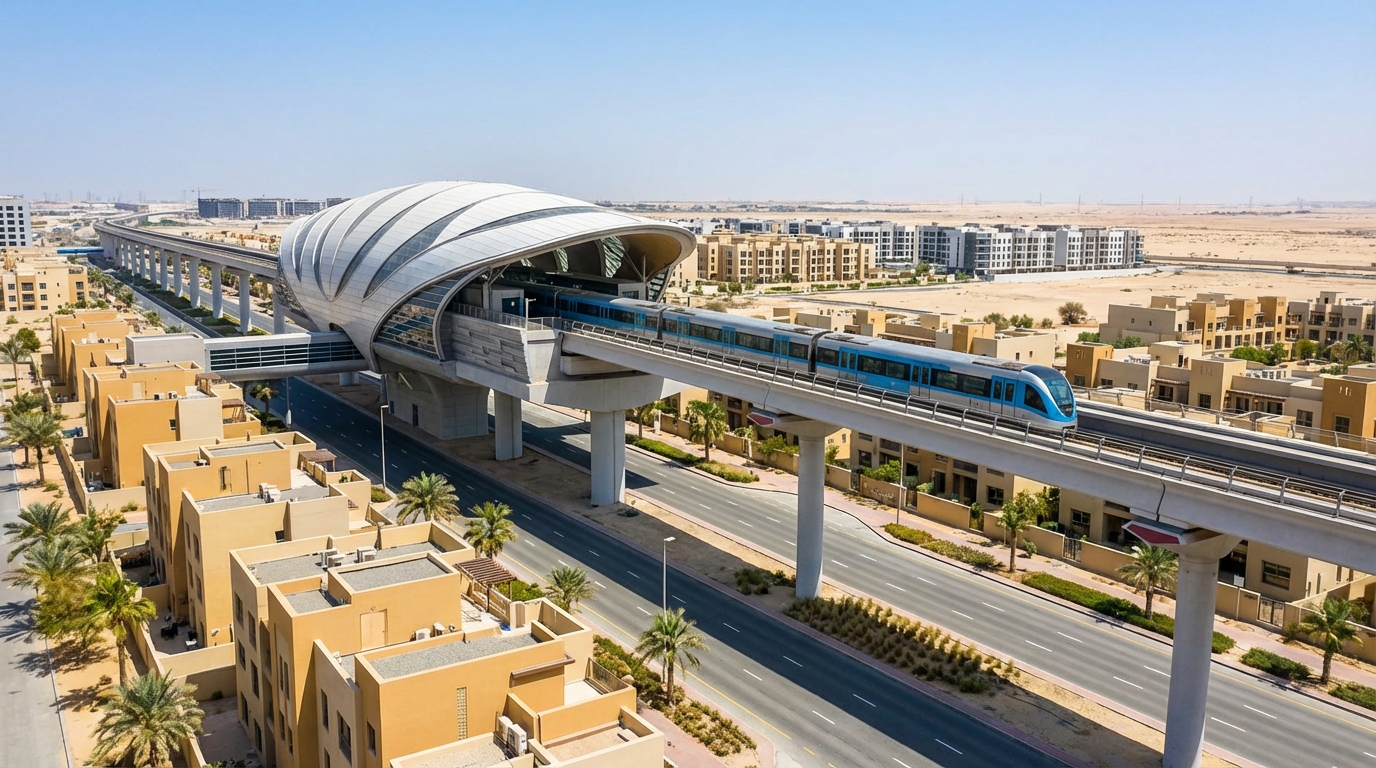
AI-generated reference image
Dubai Metro Blue Line
30 km
14 stations connecting underserved corridors
The third metro line will link Dubai International Airport to key residential corridors including Al Jadaf, International City, and Academic City. Communities along the Blue Line corridor currently trade at significant PSF discounts to metro-connected areas. Historical data from Red and Green Line launches shows 15-25% appreciation premiums within 500 meters of new stations.
Status: RTA approved, construction tendering phase
Timeline: Completion targeted before 2030
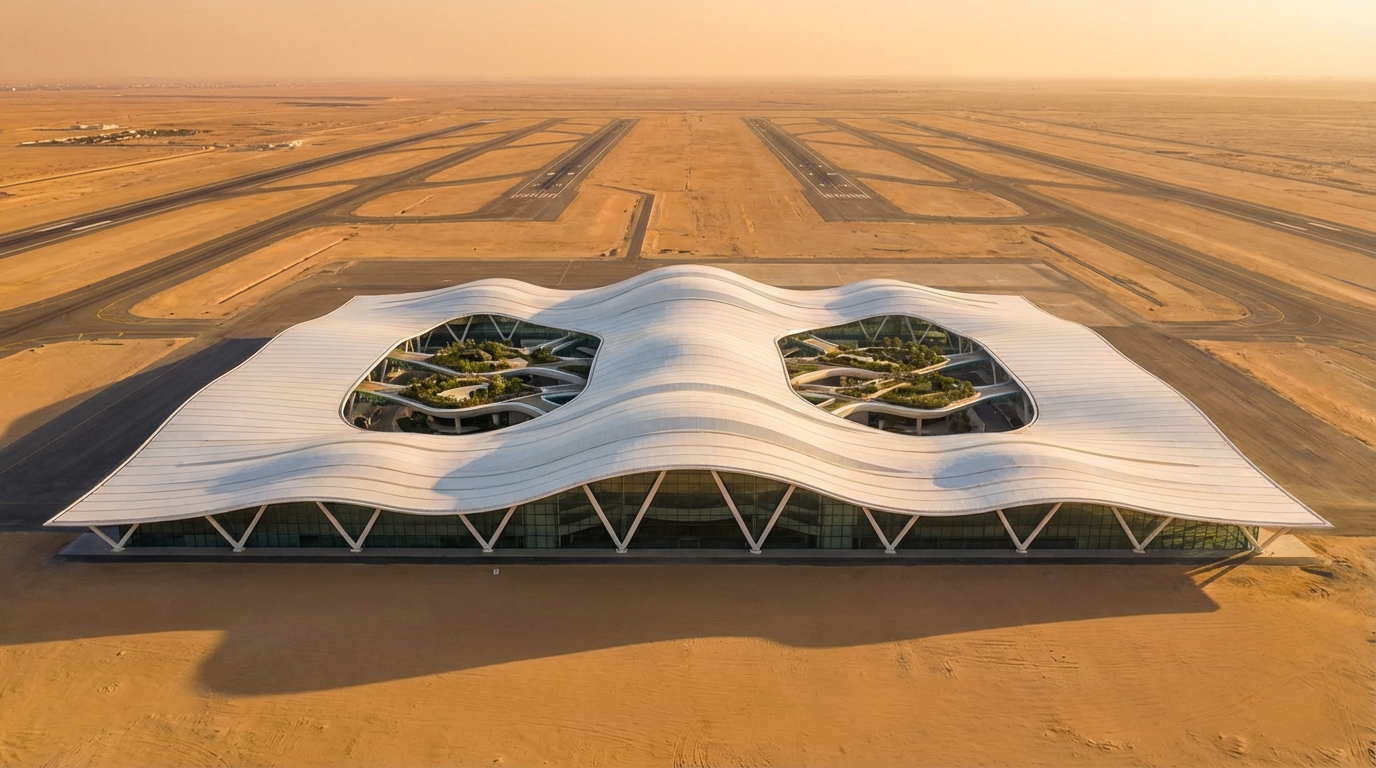
AI-generated reference image
Al Maktoum International Airport
AED 128B
260 million annual passenger capacity at full build
The world's largest airport will anchor Dubai South, a planned city the size of Singapore. Phase 1 activation alone is projected to create over 100,000 jobs in the surrounding logistics, aviation, and hospitality sectors. Dubai South residential communities currently trade at AED 800-1,200 PSF, among the most affordable in the city. The airport's gravitational pull on employment and connectivity could catalyze the same value compression seen around DXB Terminal 3.
Status: Construction commenced, enabling works underway
Scale: 5x Terminal 3 capacity at full build-out
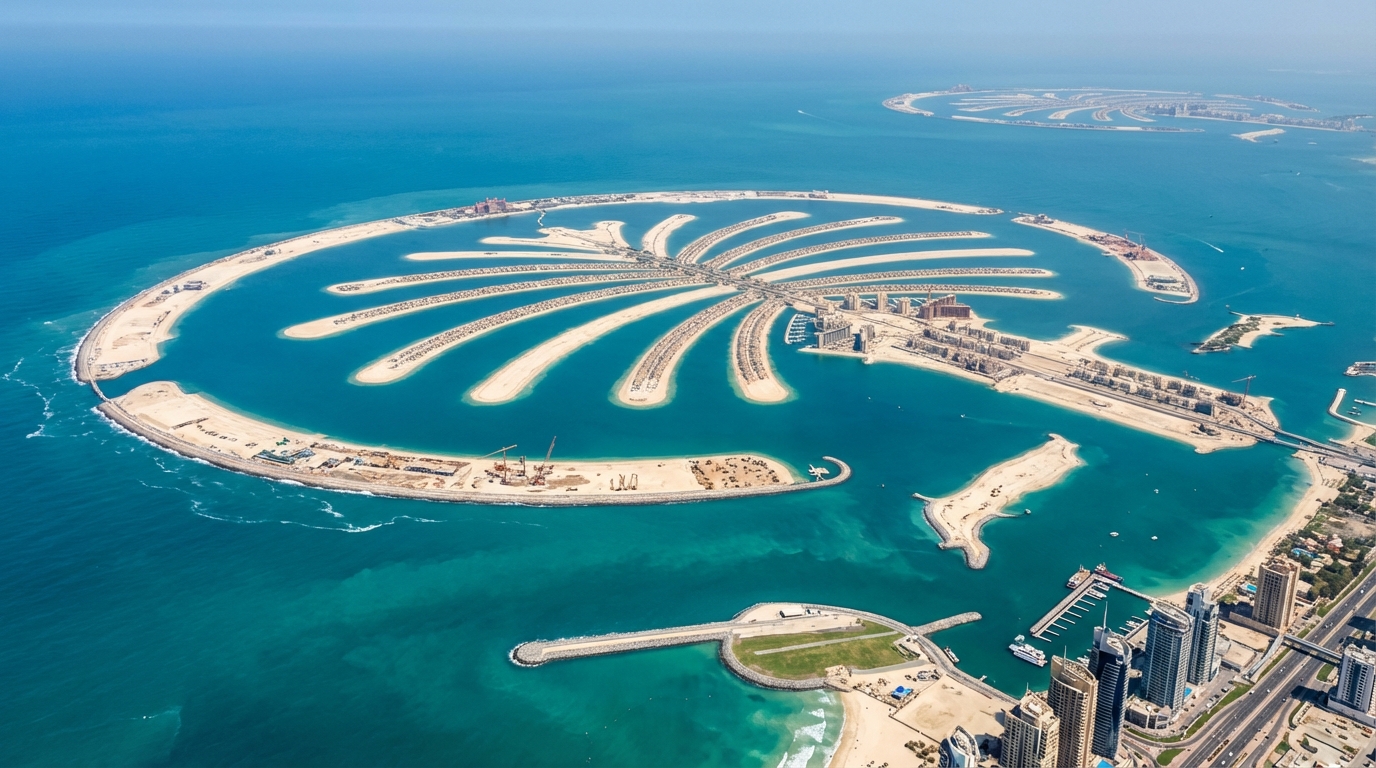
AI-generated reference image
Palm Jebel Ali Revival
110 km
New coastline with 80 hotels and over 35,000 residences
Originally shelved during the 2008 financial crisis, Palm Jebel Ali has been revived as a landmark waterfront destination by Nakheel. At twice the size of Palm Jumeirah, the project will add significant premium inventory to the market. Adjacent communities including Dubai Maritime City and JBR could benefit from the expanded coastline effect, though the sheer scale of new supply will require careful absorption monitoring over a multi-year handover cycle.
Status: Reclamation and infrastructure in progress
Impact: 110 km of new coastline added to Dubai
Market Context
These three projects represent a deliberate strategy to expand Dubai's geographic footprint rather than densify existing corridors. For investors, the implication is a potential bifurcation: established communities near new infrastructure will see connectivity premiums, while some may face increased competition from new supply entering the market. The historical pattern from Palm Jumeirah and DIFC development suggests that infrastructure-led value creation typically takes 5-8 years to fully materialize, with early entrants capturing the steepest appreciation curves.
We accept a limited number of engagements per quarter to ensure analytical rigor and dedicated attention for our clients.
Disclaimer: Dubai Home provides historical transaction data and market analysis for educational and informational purposes only. This content does not constitute financial, investment, or legal advice. Past performance does not indicate future results. Always consult a licensed professional before making property decisions. All data sourced from Dubai Land Department official transaction records.